|
‘The Preston
Pals fought with distinction on the Western Front and were
driven by a steadfast
determination to fulfil their duty to their King and Country
by confronting the face of battle.’
There is no official Memorial to the Preston
Pals, except some that are listed on the Harris Museum's
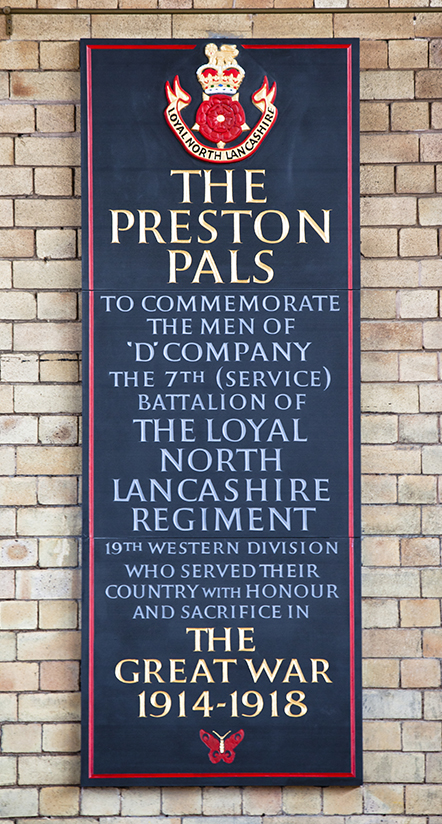
Roll of Honour. Our aim is to create a permanent Memorial to
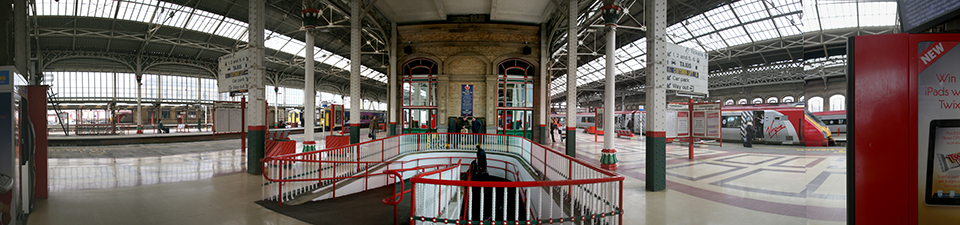
be placed on Preston Railway station, as this was probably
the last place most of the company saw as they departed for
the Great War.
The
company was formed in 1914 after the Secretary of State for
War Earl Kitchener called for a volunteer army. The idea was
to encourage groups of friends or 'pals' to sign up and go
to war together. Many Pals companies sprung up in northern
industrial towns, the most famous in this area being the
Accrington Pals.
The late Joe Hodgson, a volunteer at the Queen's Lancashire
Regiment Museum in Fulwood, said men 'were sleeping outside
on the floor they were so keen to join up'. An advert for
the Pals was published in the Lancashire Daily Post on
August 31, 1914, and ran for four days.
It read: 'Will those who would like to join apply here any
afternoon or evening this week – the earlier the better.
Cyril Cartmell, Town Hall, Preston.'
Consequently the Preston Pals became known as Cartmell's
company. It was a quick way of getting men to enlist and
after three days enough men had been recruited.
The Preston Pals then became 'D' company, 7th Battalion, the
Loyal North Lancashire Regiment. They were medically
examined and took their allegiance to the King and paraded
on the Flag Market before being sent off for training at
Tidworth in Wiltshire.
Sadly, little is known about the Preston Pals. Although they
were part of the 7th Battalion, they were not actually
documented as a Pals unit in the official Regimental
histories. This is probably because they were only a
company, when most other Pals units were battalions. Also,
there is no war memorial dedicated to the Pals and only some
are listed on the Harris Museum's roll of honour.
Once their training was over, the Pals were mobilized with
the 7th LNL and sailed for France on 16th and 17th July
1915. From then on, it was all go, with route marches,
inspections, specialised training and trench digging. On
25th September 1915 when the Battle of Loos began, the
battalion was in reserve south of Laventie in the northern
part of the battlefield and they were moved up to the front
line three days later. Their first taste of battle was in
the Orchard Salient, when the Pals were ordered to hold the
front line with A Company. Although the Germans were not
particularly active, this was considered to be a dangerous
part of the line.
The concept of Pals units was dealt a fatal blow on the
Somme on 1st July 1916 and it was the fate of the 31st
Division in particular, which included the Accrington,
Bradford and Leeds Pals, which convinced the Army that a
concentration of casualties from the same area needed to be
avoided in future. It was of these units that it would be
said, “They were two years in the making and ten minutes in
the destroying.”
The Preston Pals and the 7th Bn LNL were in support during
the initial attacks, but were moved up to strengthen the
line at La Boisselle later in the day and it was here that
they would be heavily committed for the next few days.
After the shock of heavy losses on 1st July, which still
rank as the worst in the history of the British Army, the
High Command looked to capitalise on major gains south of
the Albert-Bapaume road. Two weeks later, revised tactics
met with spectacular success and the Germans were driven
back from the Bazentin Ridge on a front of over 6,000 yards.
The British were now learning how to attack their |

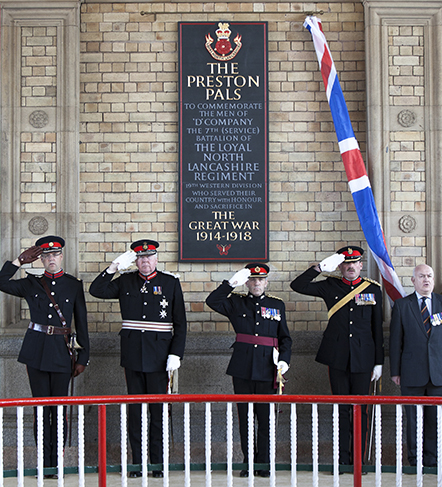
This
is a visual representation of how the memorial will look in
its final position on Preston Railway Station, from where
the Pals departed Preston
tenacious and well organised enemy, but in their turn, the
Germans were adopting new tactics in defence to repel their
own enemy’s determined aggression.
During the early hours of 23rd July,the 7th Bn LNL attacked
from the north of the village of Bazentin-le-Petit in the
direction of Martinpuich and were met by fierce resistance.
Well positioned machine guns brought the attack to a
standstill and retreat to the starting point was the only
option. The Battalion War Diary records that they received
orders to attack on a 300 yards front at 12.25 am and
“reached the first objective but suffered very heavy
casualties”. The Pals in D Company also “had heavy
casualties . . .” and “Captain Thompson and 2nd Lt. Hoyle
were killed. The Company had got to within a few yards of
the German Front Line, but was again held up by machine
guns”.
It is difficult to assess just how many of the Preston Pals
were lost on that day and research is ongoing to find a
final number. However, casualties for the whole 7th
Battalion LNL came to 10 officers and 213 other ranks,
killed, wounded or missing.
On 7th June 1917, when the Flanders Offensive began at
Messines, it would be an altogether different story.
Following the explosion of nineteen mines along the Messines
Ridge, C and D Companies led the attack on the battalion
front and captured all their objectives. According to the
Battalion War Diary casualties were slight. During the Great
War, the Preston Pals fought with distinction on the Western
Front and theirs was a typical Pals unit. Imbued with an
intense pride in their roots, they would train and fight
alongside friends and family in the pursuit of justice and
glory. They, as all the volunteers who flocked to the
Colours, were driven by a steadfast determination to fulfil
their duty to their King and Country by confronting the face
of battle. |

You can give
your support by making a small donation.
Please send a cheque
made payable to
Preston Pals War Memorial
Trust by
downloading a subscription form
HERE
and print out and send to us with your kind donation
or set up
a regular giving amount by standing order, please
contact us
HERE
|